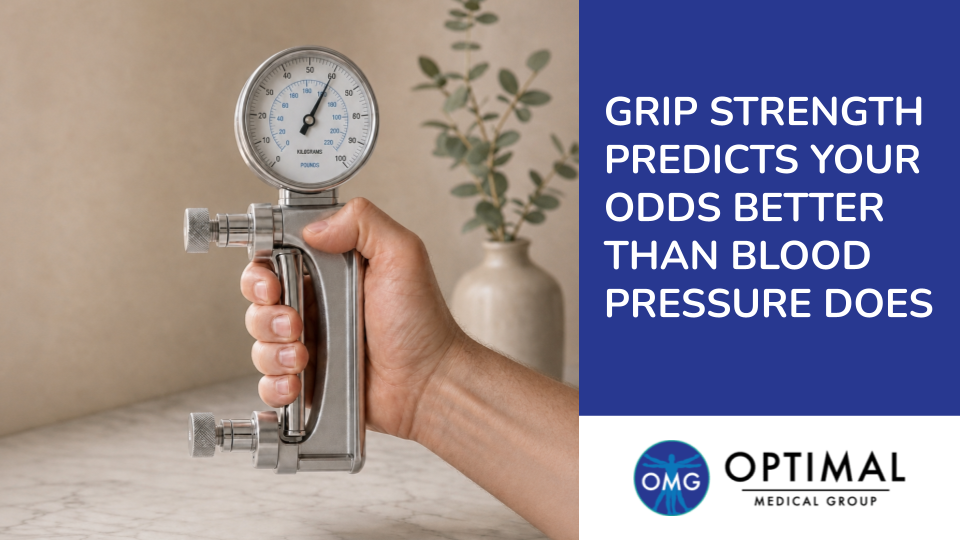
A grip strength test predicts mortality risk better than a blood pressure reading does. The test takes under a minute: a firm squeeze on a handheld device that records force in kilograms. That single number reflects total body muscle quality, nerve efficiency, and recovery capacity, which is why it tracks so closely with long-term outcomes.
Adults in midlife and beyond who want measurable markers of healthy aging gain the most from knowing their number. It matters because grip strength is simple to measure, easy to interpret, and it improves with training at any age, which makes it one of the most useful numbers to track over time.
Key Takeaways of the Grip Strength Test
A grip strength test uses a handgrip dynamometer, a handheld device that measures squeezing force in kilograms. The test takes under a minute and requires no needles, fasting, or special preparation.
The result reflects far more than hand strength. Grip force mirrors total body muscle quality, how efficiently nerves activate muscle, and how well the body recovers.
Lower grip strength is linked to higher risk of cardiovascular events and death from any cause. As a predictor of mortality, grip strength outperforms systolic blood pressure, one of the most familiar numbers in any chart.
Grip strength peaks in early adulthood and declines gradually with age, often faster after 50. A low reading can flag sarcopenia, the age-related loss of muscle mass and function, before it shows up in daily life.
Unlike many risk markers, grip strength responds directly to effort. Resistance training raises it at any age, and each repeat test confirms the gain in a number that is easy to see.
The OMG Signature Concierge Longevity Program measures grip strength at baseline and repeats it alongside body composition. Reading strength and muscle together shows whether training is building the kind of muscle that supports long-term health.
What a Grip Strength Test Measures
A grip strength test is one of the simplest assessments in preventive medicine. The value lies in what that quick squeeze reveals about the rest of the body.
How a Handgrip Dynamometer Works
A handgrip dynamometer looks like a sturdy handle with a gauge attached. The person being tested sits upright with the elbow bent at about 90 degrees and squeezes the handle as hard as possible for a few seconds. The device reports the peak force in kilograms.
The test is usually repeated two or three times on each hand, and the best result is recorded. Standard positioning allows each new reading to be compared fairly with the last one.
Why Grip Reflects Whole-Body Strength
Squeezing a handle seems like a narrow task, but it draws on systems throughout the body. Strong grip depends on healthy muscle fibers, efficient signaling from the nervous system to those fibers, and the body's capacity to build and repair tissue.
Grip strength correlates closely with strength in the legs, back, and core. A declining grip often signals that muscle quality is declining elsewhere, even before stairs, lifting, or balance become noticeably harder.
Why Grip Strength Outperforms Blood Pressure
Blood pressure is checked at nearly every medical visit, while grip strength is rarely measured at all. Yet as a predictor of mortality, grip strength outperforms systolic blood pressure. The reason lies in what the number captures.
What Grip Strength Captures
Grip strength captures physical reserve: how much functional capacity the body holds in store against illness, injury, and aging. Muscle quality, nerve efficiency, and recovery all feed into that single reading, which is why it tracks so closely with long-term outcomes.
Lower grip strength is associated with higher rates of heart attack, stroke, and death from any cause. Blood pressure remains essential for managing cardiovascular risk, and grip strength adds a dimension of risk that a blood pressure cuff cannot measure.
One Marker Among Several
No single test predicts a person's entire future health. Grip strength works best as part of a broader picture that includes blood pressure, body composition, cardiovascular fitness, and blood biomarkers.
What sets grip strength apart is how much information it delivers for how little effort. It is fast, painless, and repeatable, yet it often goes unmeasured for years.
Grip Strength by Age and What Low Readings Mean
Grip strength follows a predictable arc across a lifetime. A result well below the expected range for age and sex calls for a closer look.
How Grip Strength Changes With Age
Grip strength typically peaks between the late 20s and around 40, then declines slowly. The decline often speeds up after 50 as muscle mass and nerve function change. Men generally measure higher than women at every age, so results are interpreted against age- and sex-matched norms.
As a general reference, readings below about 27 kilograms in men and 16 kilograms in women are widely used to flag low muscle strength. A downward trend across repeat tests can matter as much as any single reading.
Sarcopenia and Early Detection
Sarcopenia is the gradual loss of muscle mass, strength, and function that comes with aging. It raises the risk of falls, fractures, frailty, and loss of independence. Low grip strength is one of the primary screening markers for it.
Catching declining strength early shifts the focus from reacting to symptoms to managing risk. A low or falling grip strength reading prompts a closer look at body composition, activity, nutrition, and overall health while there is still ample room to rebuild.
How to Improve Grip Strength at Any Age
Grip strength earns its place in a health assessment because it responds to effort. Progress shows up in the next measurement as a clear, objective gain.
Resistance Training That Builds Grip
Full-body resistance training is the foundation. Exercises such as deadlifts, rows, pull-ups, and farmer's carries build grip naturally while strengthening the legs, back, and core. Training two to three times per week with gradually heavier loads drives steady progress.
Targeted work can add to that base. Dead hangs from a bar, holding weights for time, and squeezing a firm grip trainer all challenge the hands and forearms directly.
Tracking Progress With Repeat Testing
A baseline reading sets the starting point. Repeat tests under the same conditions show whether training is working.
Pairing grip strength with body composition adds depth. Rising grip strength alongside stable or growing lean muscle mass confirms that training is building functional muscle. The OMG Signature Concierge Longevity Program measures grip strength at baseline and repeats it alongside body composition, so both trends can be read together.
Grip Strength Testing and Longevity Care in Fresno, California (CA)
Optimal Medical Group offers the OMG Signature Concierge Longevity Program for adults who want measurable, trackable markers of healthy aging. Grip strength is measured at baseline and repeated alongside body composition, so progress is documented in clear numbers.
Frequently Asked Questions About the Grip Strength Test
What Does a Grip Strength Test Measure?
A grip strength test measures the maximum force the hand can produce, recorded in kilograms with a handgrip dynamometer. The result reflects overall muscle quality, nerve efficiency, and recovery capacity, not just hand strength.
Does Grip Strength Predict Health Better Than Blood Pressure?
For mortality, yes. Grip strength predicts risk of death more strongly than systolic blood pressure. Blood pressure remains essential for managing heart and vascular health, so the two work best together.
What Is a Good Grip Strength for My Age?
Healthy ranges depend on age and sex, and men typically measure higher than women. Readings below about 27 kilograms in men and 16 kilograms in women are commonly used to flag low strength.
Can Grip Strength Be Improved After 50?
Yes. Resistance training raises grip strength at any age. Lifts such as deadlifts and rows, loaded carries, and dead hangs build grip steadily, and repeat testing confirms the gain.
Conclusion and Summary of the Grip Strength Test
A grip strength test takes under a minute and delivers one of the most informative numbers in preventive health. A handgrip dynamometer records squeezing force in kilograms, and that figure reflects total body muscle quality, nerve efficiency, and recovery capacity.
Lower grip strength is linked to higher cardiovascular and all-cause mortality risk, and it predicts mortality more strongly than systolic blood pressure. It works best alongside other markers, and readings well below age- and sex-matched norms can flag sarcopenia early, while there is still time to rebuild.
Grip strength also responds to effort. Resistance training raises it at any age, and repeat testing confirms the progress. The OMG Signature Concierge Longevity Program in Fresno measures grip strength at baseline and repeats it alongside body composition, turning one minute and one number into years of useful information.
Schedule your Longevity Program consultation here, or call us today at (559) 840-0066 and discover how proactive, measurable care is helping patients across Fresno, California build stronger, healthier years ahead!
Testosterone is the most abundant active sex hormone in a woman's body, and its level shapes how strong, focused, and motivated she feels. It circulates at lower concentrations than in men, yet it does substantial work, from building lean muscle and maintaining bone to driving a significant share of libido.Women in their thirties, forties, and…
Visceral fat, the fat packed around the liver, pancreas, and intestines, behaves like an active organ rather than simple storage. It releases inflammatory signals into the bloodstream and drives insulin resistance. Losing it delivers one of the fastest health returns in weight loss, and a DEXA scan can measure it directly, in grams.Adults working to…
Most thyroid panels stop at TSH and leave out thyroid antibodies, the test that shows whether the immune system is attacking the gland. Antibodies often appear years before hormone levels shift, which makes them the earliest warning sign available for autoimmune thyroid disease, the most common cause of thyroid dysfunction.Adults who feel tired, foggy, or…
The strongest P-Shot® results come to men who treat the therapy as a plan rather than a single appointment. Each treatment builds new blood vessel growth on top of the last, so circulation improves from a stronger starting point every time. Results also depend on what surrounds the treatment, especially hormone levels and blood sugar…