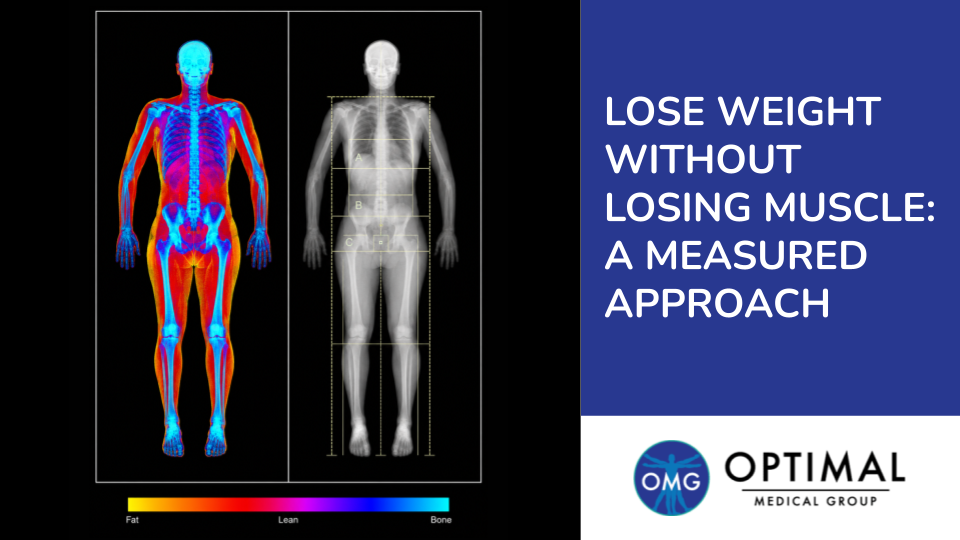
The ability to lose weight without losing muscle decides how much of that weight stays off. A scale reports one number and cannot separate fat from muscle. In an aggressive calorie deficit, roughly a third of lost weight can come from fat-free mass, which includes muscle. That matters because lean mass is the tissue driving resting metabolic rate.
A DEXA scan separates fat, lean tissue, and visceral fat directly. Repeated during treatment, it shows whether a plan is working or simply making the number smaller. Protein targets, resistance training, and a controlled rate of loss are what preserve lean tissue. The next scan then confirms whether the approach succeeded.
Measuring body composition turns weight loss into a process that protects muscle while the fat comes off.
Key Takeaways of How to Lose Weight Without Losing Muscle
The bathroom scale is the most common way people track weight loss. Yet it measures only total body mass. It cannot reveal what that mass is made of or what is actually being lost.
One Number Hides Two Tissues
Body weight combines fat, muscle, bone, water, and organs into a single figure. When that figure drops, the scale cannot say which tissue changed. A lower number can reflect fat loss, muscle loss, or both.
That limitation matters because fat and muscle behave very differently. Losing fat improves health and body composition. Losing muscle weakens the body and slows metabolism, even though the scale treats both the same way.
Why Two People Down Ten Pounds Can Have Opposite Results
Imagine two people who each lose ten pounds. One loses mostly fat while keeping muscle. The other loses a large share of muscle along with some fat.
On the scale, their results look identical. In reality, the first person is stronger and better positioned to keep the weight off. The second person faces a slower metabolism and a harder road ahead.
How Much Muscle Is Lost During Weight Loss
Weight loss almost always includes some loss of lean tissue. The question is how much. The answer depends heavily on how the weight comes off.
Lean Mass Loss in an Aggressive Calorie Deficit
In people with overweight or obesity, fat-free mass typically makes up about 20% to 30% of total weight lost. That share can rise when weight comes off too quickly. When two diets produced similar weight loss, the faster approach caused a greater loss of fat-free mass.
An aggressive deficit pushes the body to find energy wherever it can. Muscle becomes one of those sources. That is why the speed and structure of a weight loss plan matter as much as the final number.
Why Lean Mass Sets Resting Metabolic Rate
Muscle is metabolically active tissue that burns energy even at rest. The more muscle mass a person has, the faster the metabolism. The more lean mass a person keeps, the more calories the body burns throughout the day.
Protecting lean tissue keeps maintenance manageable once the weight is gone. Greater loss of fat-free mass has also been linked with more weight regain after a diet ends. Muscle is what makes a result sustainable.
How a DEXA Scan Separates What the Scale Cannot
DEXA stands for dual energy X-ray absorptiometry. It is a quick, low-dose scan that measures body composition in detail. Unlike a scale, it shows exactly what the body is made of.
Measuring Fat, Lean Tissue, and Visceral Fat
A DEXA scan reports fat mass, lean tissue, and bone separately. It is superior to body mass index for detecting changes in fat and lean body mass. That precision makes it a valuable tool in weight management.
DEXA can also estimate visceral fat, the metabolically active fat stored around the organs. Visceral fat is strongly associated with type 2 diabetes, hypertension, and subclinical atherosclerosis. Tracking it shows whether the most harmful fat is shrinking.
Repeating the Scan During Treatment
A single DEXA scan sets a baseline. The real value appears when the scan is repeated during treatment. Each follow-up scan shows what is actually coming off.
If fat is dropping while lean tissue holds steady, the plan is working. If lean tissue is falling, the plan needs adjustment. Without the scan, that difference would stay hidden behind a smaller number on the scale.
How to Lose Weight Without Losing Muscle
Preserving muscle during weight loss is not left to chance. It depends on specific, measurable strategies. When combined, they shift weight loss toward fat and away from lean tissue.
Protein Targets and Resistance Training
Protein supplies the building blocks muscle needs to maintain itself. High protein intake, about 1.25 to 1.5 times the recommended allowance, is advised during weight loss therapy to limit muscle loss. Higher intake is recommended for people who exercise.
Resistance training gives muscle a reason to stay. Exercise training combined with sufficient protein helps preserve fat-free mass during weight loss in adults with obesity. Together, these two strategies protect the tissue that drives metabolism.
A Controlled Rate of Loss, Confirmed by the Next Scan
A controlled rate of loss completes the approach. Moderate, steady progress gives the body less reason to break down muscle for energy. It also makes the plan easier to sustain.
The next DEXA scan confirms whether the strategy worked. It shows whether fat came off while muscle held. That feedback allows the plan to be adjusted with precision rather than guesswork.
Frequently Asked Questions About How to Lose Weight Without Losing Muscle
Is it possible to lose weight without losing muscle?
Yes, largely. Some lean tissue loss is common, but adequate protein, resistance training, and a controlled rate of loss help preserve muscle while fat comes off.
How much muscle is lost during weight loss?
In people with overweight or obesity, fat-free mass often accounts for about 20% to 30% of weight loss. That share can be higher with very rapid weight loss.
Why does losing muscle slow metabolism?
Muscle burns energy even at rest, and lean mass is a main driver of resting metabolic rate. Losing muscle lowers the number of calories the body burns each day.
How does a DEXA scan help during weight loss?
A DEXA scan measures fat, lean tissue, and visceral fat separately. Repeated during treatment, it shows whether weight loss is coming from fat or muscle.
What helps preserve muscle during weight loss?
Higher protein intake, regular resistance training, and a steady rate of loss all help. Follow-up body composition scans confirm whether these strategies are working.
Conclusion and Summary of How to Lose Weight Without Losing Muscle
The weight that stays off is decided by how much muscle is protected along the way. A scale reports one number and cannot tell fat from lean tissue. In an aggressive deficit, a meaningful share of the loss can come from muscle, which drives resting metabolic rate.
A DEXA scan separates fat, lean tissue, and visceral fat directly. Repeated during treatment, it reveals whether a plan is truly working. Protein targets, resistance training, and a controlled rate of loss preserve lean tissue, and the next scan confirms it. With a measured approach, weight loss becomes fat loss, and the results are built to last.
Schedule Your Regenerative Medicine Consultation here, or call us today at (559) 840-0066 and discover how these therapies are helping patients across Fresno, California reclaim active, pain-free lives!
Cover Image Illustration by: The Optimal Medical Group.
VO2 max and longevity are tightly linked, because cardiorespiratory fitness is one of the strongest predictors of how long a person lives. Of everything measurable about the body today, fitness carries enormous weight, and it can be raised on purpose. VO2 max is the volume of oxygen the body can use per minute at maximum…
An ApoB test gives a clearer read on cardiovascular risk than anything on a standard lipid panel. Apolipoprotein B, written ApoB, is a protein found on every particle capable of causing plaque. LDL cholesterol measures the cholesterol cargo riding inside those particles. ApoB counts the particles themselves, and each atherogenic particle carries exactly one ApoB…
The P-Shot® targets blood flow first, because stronger, more reliable erections are a circulation result before they are anything else. An erection depends on endothelial function, the health of the thin cell layer lining every blood vessel. Those cells release nitric oxide, which relaxes the vessel wall and allows blood to fill the tissue under…
Free testosterone is the small, active portion of testosterone that tissues can actually use, and it can run low even when total testosterone looks normal. Most lab panels report only total testosterone, which counts every molecule in the blood. Much of that total is bound to a protein called sex hormone binding globulin, or SHBG,…