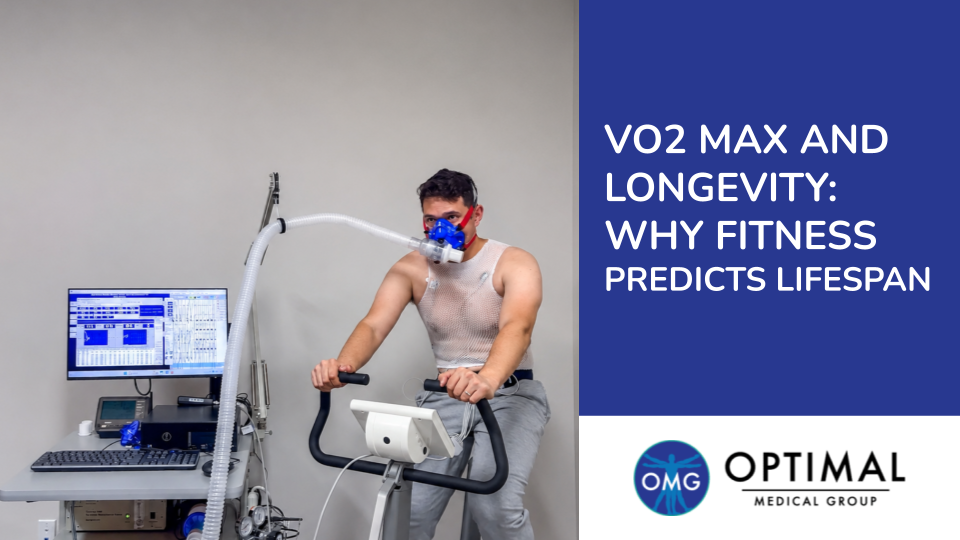
VO2 max and longevity are tightly linked, because cardiorespiratory fitness is one of the strongest predictors of how long a person lives. Of everything measurable about the body today, fitness carries enormous weight, and it can be raised on purpose. VO2 max is the volume of oxygen the body can use per minute at maximum effort. It reflects how well the heart, lungs, blood, and mitochondria perform as one system.
Low fitness has been linked with a mortality risk comparable to or greater than smoking and diabetes. The encouraging part is the response curve. The largest survival gains come from moving out of the lowest fitness levels, and fitness is trainable at any age. Accurate VO2 max testing shows exactly where that journey begins.
Cardiopulmonary exercise testing during maximal graded exercise is the gold standard for measuring VO2 max.
Smartwatch VO2 max estimates can show poor individual-level agreement with laboratory testing.
Why VO2 Max Is a Powerful Predictor of Longevity
Most people think of blood pressure or cholesterol when they consider long-term health. Cardiorespiratory fitness belongs at the top of that list. It captures how well the entire body performs, which makes it a remarkably strong signal.
Fitness Compared With Traditional Risk Factors
Cardiorespiratory fitness is potentially a stronger predictor of mortality than established risk factors. Those factors include smoking, hypertension, high cholesterol, and type 2 diabetes. Adding fitness to traditional risk factors also improves how accurately risk is assessed.
Among more than 122,000 adults, low fitness carried a risk comparable to or greater than smoking, diabetes, and coronary artery disease. That makes fitness far more than a measure of athletic ability.
A Number That Can Be Raised on Purpose
Many risk factors are difficult or impossible to change. Genetics cannot be rewritten, and age only moves in one direction. VO2 max is different.
Fitness responds directly to consistent training. That makes it one of the most actionable numbers in preventive medicine. Improving it is a deliberate choice that pays off in measurable ways.
What VO2 Max Actually Measures
VO2 max sounds technical, but the concept is simple. It measures how much oxygen the body can put to work. That single number reflects the performance of several systems at once.
Oxygen Use at Maximum Effort
VO2 max is the maximum amount of oxygen a person can use during exercise. It is usually expressed in milliliters of oxygen per kilogram of body weight per minute. Higher values mean greater aerobic capacity.
The number is captured when a person works at their hardest. At that point, the body cannot take in or use any more oxygen. That ceiling defines how much physical work the body can sustain.
Heart, Lungs, Blood, and Mitochondria Working Together
Reaching a high VO2 max depends on several systems working as one. The lungs bring oxygen into the body. The heart pumps oxygen-rich blood to the muscles.
The blood carries that oxygen, and the mitochondria inside muscle cells use it to produce energy. A weakness anywhere in that chain lowers the final number. That is why VO2 max serves as a window into whole-body health.
Where the Biggest Longevity Gains Come From
The relationship between fitness and survival is not a straight line. The biggest gains sit at the bottom. That makes improvement especially valuable for people who are starting with low fitness.
Moving Up From the Lowest Fitness Levels
Low fitness stands out as an independent predictor of death in both men and women. Moderate fitness, by contrast, helps protect against the influence of other risk factors. Moving out of the lowest group delivers some of the largest survival benefits available.
Even modest progress counts. Improvements of as little as one metabolic equivalent were linked with lower risk of death compared with no change. Small, steady gains in fitness can meaningfully change the outlook.
Every Step Above Average Still Pays
The benefits do not stop once a person reaches average fitness. Higher fitness continued to track with lower mortality, with no upper limit observed. Even the fittest group had the lowest risk.
Gains above average tend to come in smaller increments. Still, each step up continues to pay off. Fitness remains worth building at every level.
How to Measure and Improve VO2 Max
Knowing a VO2 max value turns fitness into a clear, trackable target. Accuracy matters because a plan is only as good as the number it is built on. Once you measure your VO2 max, structured training can help you improve it.
Estimates Are Not Measurements
Cardiopulmonary exercise testing during maximal graded exercise is the gold standard for measuring VO2 max. A proper test uses a mask and a graded protocol that gradually increases effort. The mask captures oxygen use and carbon dioxide output directly.
Wrist-worn devices only estimate the number. Smartwatch estimates can show poor individual-level agreement with laboratory testing. A wrist estimate can suggest a trend, but it is not a number to plan from.
Trainable at Any Age, Confirmed on the Next Test
VO2 max improves with the right training. About 16 weeks of exercise can raise cardiorespiratory fitness by roughly one metabolic equivalent, regardless of age or sex. Structured aerobic work produces measurable change within months.
That is why testing before training makes sense. A baseline test sets clear targets for the plan. A follow-up test then confirms how much fitness has improved.
Frequently Asked Questions About VO2 Max and Longevity
What is VO2 max?
VO2 max is the maximum amount of oxygen the body can use per minute during intense exercise. It reflects how well the heart, lungs, blood, and muscles work together.
Yes. Structured aerobic training can raise cardiorespiratory fitness regardless of age or sex, often within a few months.
How is VO2 max measured accurately?
Cardiopulmonary exercise testing provides the most accurate measurement of VO2 max.. The test uses a mask and a graded exercise protocol to capture oxygen use directly.
Conclusion and Summary of VO2 Max and Longevity
VO2 max and longevity are closely connected. Cardiorespiratory fitness predicts mortality as strongly as, or more strongly than, many traditional risk factors. VO2 max measures how much oxygen the body can use at maximum effort, reflecting the heart, lungs, blood, and mitochondria together.
The biggest survival gains come from moving out of the lowest fitness levels, and every step above continues to pay. Accurate measurement requires a proper test with a mask and graded protocol, not a wrist estimate. Because fitness is trainable at any age, testing first and training with purpose can steadily build a longer, healthier, and more active future.
Schedule Your Regenerative Medicine Consultation here, or call us today at (559) 840-0066 and discover how these therapies are helping patients across Fresno, California reclaim active, pain-free lives!
Cover Image Illustration by: The Optimal Medical Group.
The ability to lose weight without losing muscle decides how much of that weight stays off. A scale reports one number and cannot separate fat from muscle. In an aggressive calorie deficit, roughly a third of lost weight can come from fat-free mass, which includes muscle. That matters because lean mass is the tissue driving…
An ApoB test gives a clearer read on cardiovascular risk than anything on a standard lipid panel. Apolipoprotein B, written ApoB, is a protein found on every particle capable of causing plaque. LDL cholesterol measures the cholesterol cargo riding inside those particles. ApoB counts the particles themselves, and each atherogenic particle carries exactly one ApoB…
The P-Shot® targets blood flow first, because stronger, more reliable erections are a circulation result before they are anything else. An erection depends on endothelial function, the health of the thin cell layer lining every blood vessel. Those cells release nitric oxide, which relaxes the vessel wall and allows blood to fill the tissue under…
Free testosterone is the small, active portion of testosterone that tissues can actually use, and it can run low even when total testosterone looks normal. Most lab panels report only total testosterone, which counts every molecule in the blood. Much of that total is bound to a protein called sex hormone binding globulin, or SHBG,…