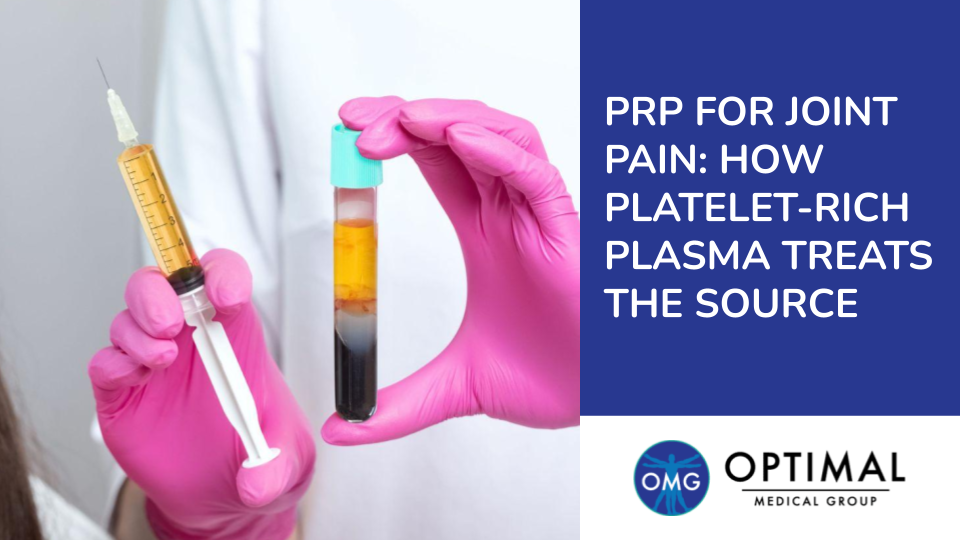
Platelet-rich plasma (PRP) for joint pain is a regenerative treatment that uses a patient's own concentrated platelets to support tissue repair at the site of injury. Platelet-rich plasma contains growth factors that stimulate healing in damaged tendons, ligaments, and cartilage, tissues that often struggle to repair on their own. Unlike pain medications or cortisone injections that mask symptoms, PRP targets the underlying tissue damage that keeps joint pain coming back.
The treatment is performed in a single office visit, requires no surgery or general anesthesia, and uses nothing foreign to the body. For joints that have not responded to rest, physical therapy, or anti-inflammatory medication, PRP offers a targeted, restorative approach worth understanding.
Key Takeaways of PRP for Joint Pain
PRP is a biologic treatment derived from the patient’s own blood that concentrates platelets and growth factors to stimulate tissue healing.
A retrospective study of 252 patients found clinically significant improvements in pain and function at six and twelve months following PRP treatment for large joint osteoarthritis.
Ultrasound guidance allows the physician to place the injection precisely at the target tissue, improving accuracy and outcomes.
PRP treatment is a same-day, in-office procedure with no surgery, no general anesthesia, and minimal downtime.
What PRP Is and How It Works
PRP stands for platelet-rich plasma. It is made from a small sample of the patient's own blood, processed to concentrate the healing components the body already produces.
The Biology Behind PRP
Platelets are best known for blood clotting. But they also carry growth factors and proteins that play a critical role in tissue repair. These include platelet-derived growth factor, transforming growth factor, and vascular endothelial growth factor.
When concentrated and delivered directly to damaged tissue, these growth factors amplify the body's natural repair process. They recruit healing cells, reduce inflammation, and stimulate the production of new collagen and connective tissue at the injury site.
How PRP Is Prepared
The process is straightforward. A small amount of blood is drawn from the patient's arm, just like a routine blood draw. That sample is placed in a centrifuge, which spins it to separate the platelets from the red and white blood cells.
The result is a concentrated plasma solution with five to ten times the normal platelet count. This PRP is then injected directly into the affected joint or tissue. The entire preparation takes place during the same office visit, typically within an hour.
Why Ultrasound Guidance Makes a Difference
Not all joint injections are created equal. Where the treatment is placed matters as much as what is being injected. Ultrasound guidance brings precision to the process.
Real-Time Visualization of the Target
When a physician injects PRP under ultrasound guidance, they watch a live image of the joint throughout the procedure. The needle is visible on screen in real time. So is the target tissue, the damaged cartilage, the inflamed tendon, or the torn ligament.
This eliminates guesswork. Instead of placing the injection based on feel or external landmarks alone, the physician delivers the PRP to the exact structure that needs it. That precision is what makes the treatment effective.
Improved Accuracy for Better Outcomes
Blind injections, those placed without imaging, can miss the intended target. The joint space is small, and the structures within it are layered closely together. A misplaced injection may reach the wrong tissue or fail to reach the damaged area altogether.
Ultrasound-guided injections improve placement accuracy significantly. For patients investing in a regenerative treatment like PRP, that accuracy directly influences the quality of the result.
What the Clinical Evidence Shows
PRP is one of the most studied regenerative treatments in musculoskeletal medicine. The evidence base continues to grow, with consistent findings across joint and tendon applications.
Pain Reduction and Functional Improvement
In a retrospective analysis of 252 patients with large joint osteoarthritis, PRP produced clinically significant improvements in pain and function at six and twelve months. Pain scores improved by nearly fifty percent at six months. Functional scores showed similar gains.
A broader narrative review of PRP in musculoskeletal pain found support for its use in osteoarthritis, tendinopathies, and ligament injuries. The review noted that PRP enhances cartilage repair, reduces inflammation, and improves joint function with a favorable safety profile.
How PRP Compares to Conventional Injections
Cortisone injections are the most common conventional treatment for joint pain. They reduce inflammation quickly but do not promote tissue repair. Their effects are temporary, and repeated use can weaken cartilage and tendon tissue over time.
PRP takes a different approach. Rather than suppressing inflammation alone, it promotes the biological repair of damaged tissue. The results may take longer to appear, often several weeks, but they address the source of the problem rather than temporarily masking it.
What to Expect from a PRP Treatment
PRP is a same-day procedure performed entirely in the physician's office. There is no hospital visit, no surgical preparation, and no general anesthesia.
The Procedure Step by Step
The process begins with a standard blood draw. The blood is processed in a centrifuge to produce the concentrated PRP. The physician then cleans and prepares the injection site. Using ultrasound guidance, the PRP is delivered directly to the target tissue inside the joint.
The entire visit typically takes less than an hour. A local anesthetic may be used to numb the injection site. Most patients return to normal activity within a day or two, with some temporary soreness at the injection site.
Recovery and Timeline for Results
PRP is not an instant fix. The growth factors need time to stimulate tissue repair. Most patients begin noticing improvement within two to six weeks. Full effects may take several months to develop as new tissue forms and strengthens.
Some patients benefit from a single treatment. Others may need a second injection depending on the severity of the damage and the joint involved. A physician evaluates progress through follow-up visits and determines whether additional treatment is warranted.
Which Joints Respond Best to PRP
PRP has been used across a wide range of joints and soft tissue injuries. Certain areas respond especially well.
Knees, Shoulders, and Ankles
Knee osteoarthritis is the most commonly studied application for PRP. The evidence supporting pain reduction and functional improvement in the knee is among the strongest in regenerative medicine.
Shoulder injuries, including rotator cuff tendinopathy and adhesive capsulitis, have also shown positive responses to PRP. Ankle joints, particularly those with chronic instability or cartilage damage, benefit from the precision that ultrasound-guided PRP provides.
Tendons and Ligaments
PRP can treat more than joint pain. Doctors also use it for tendon injuries such as Achilles tendinopathy, patellar tendinopathy, and lateral epicondylitis. Ligament injuries in the knee and ankle also respond to the growth factor stimulation that PRP provides.
These soft tissue structures share a common challenge: limited blood supply. That makes natural healing slow and incomplete. PRP delivers concentrated healing factors directly to these tissues, supporting a repair process the body cannot always complete on its own.
Frequently Asked Questions About PRP for Joint Pain: How Platelet-Rich Plasma Treats the Source
What is PRP for joint pain?
PRP is a regenerative treatment that uses concentrated platelets from a patient's own blood to promote tissue repair inside damaged joints. It targets the source of pain rather than masking symptoms.
Is PRP safe?
Yes. Because PRP comes entirely from the patient’s own blood, the risk of allergic reaction or rejection remains extremely low. The most common side effect is temporary soreness at the injection site.
How long does it take for PRP to work?
Most patients notice improvement within two to six weeks. Full results may take several months as new tissue forms. The timeline depends on the severity of the injury and the joint involved.
How is PRP different from cortisone injections?
Cortisone injections reduce inflammation temporarily but do not repair tissue. PRP promotes tissue healing through growth factors. The effects of PRP develop more slowly but address the underlying damage rather than just the symptoms.
Conclusion and Summary of PRP for Joint Pain: How Platelet-Rich Plasma Treats the Source
Recurring joint pain usually means the underlying tissue damage still needs proper treatment. Pain medications dull the signal. Cortisone injections reduce inflammation temporarily. But neither repairs the cartilage, tendon, or ligament that is actually causing the problem.
PRP takes a different approach. It uses the body's own concentrated platelets to deliver growth factors directly to the damaged tissue, promoting repair at the source. When placed precisely through ultrasound guidance, the treatment reaches the exact structure that needs it. For joints that have resisted conventional treatment, PRP offers a targeted, evidence-supported path toward real, lasting improvement.
Schedule Your Regenerative Medicine Consultation here, or call us today at (559) 840-0066 and discover how these therapies are helping patients across Fresno, California reclaim active, pain-free lives!
Cover Image Illustration by: The Optimal Medical Group.
Knowing how to prevent bone loss starts with understanding two facts that most people learn too late. First, bone loss has no symptoms. There is no pain, no warning sign, and no visible clue until a fracture occurs. Second, hormones play a far bigger role in bone density than most people realize.Estrogen and testosterone both…
A DEXA scan body composition test is the clinical gold standard for measuring what the body is actually made of. It separates bone, fat, and lean muscle with clinical precision. Unlike a bathroom scale, a BMI calculation, or a handheld device, DEXA uses dual-energy X-ray absorptiometry to see inside the body. It maps exactly where…
Signs you need hormone replacement therapy often hide in plain sight. Afternoon energy crashes, fading motivation, harder workouts, mood swings, stubborn weight, and restless sleep are easy to dismiss as stress or aging. But these symptoms frequently point to a hormonal imbalance that has never been properly tested.Most people live with these changes for months…
Collagen peptides support three of the body's most important structural systems, joints, skin, and bones. Collagen is the most abundant protein in the human body, accounting for roughly thirty percent of total protein content. It forms the framework behind skin elasticity, joint cartilage, bone strength, tendons, and connective tissue.Starting in the mid-twenties, the body produces…