What Is a PDO Thread Lift?
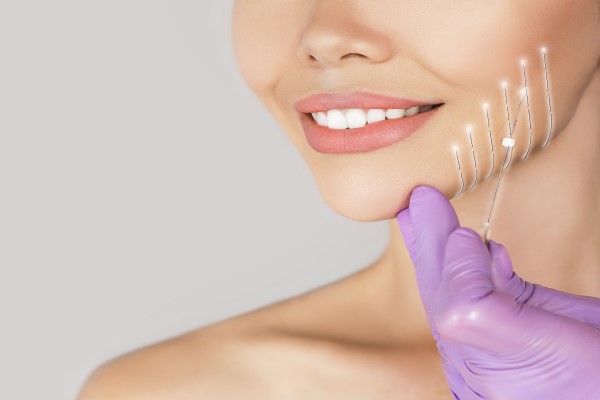
A PDO thread lift is a procedure that is performed to lift and tighten a person’s skin. It is classified as a less-invasive approach to facial rejuvenation than facelift surgery, and it does not require the use of a scalpel. It typically takes about 45 minutes or less to complete the treatment.
What to expect when getting a PDO thread lift
Polydioxanone thread lifts are mainly used for skin rejuvenation because other types of thread lifts, like PLA threads, are more effective at lifting saggy skin. The procedure is performed using PDO threads that have been around for over four decades. The material triggers cells in the patient’s body to create more collagen, a protein that gives skin its elasticity and structure. The threads used for the treatment dissolve in the patient’s body in about six months.
Collagen production slows down as a person ages, and it is responsible for most of the aging issues that affect how the skin looks. The three main types of PDO threads used for facelifts are:
- PDO cog threads: These threads have tiny barbs that latch onto the patient’s skin, providing support and lifting the skin on their face
- PDO mono threads: These are smooth threads that stimulate collagen production, rejuvenating their skin
- PDO screw threads: These are used to restore volume to sunken parts of a patient’s face, and they are made up of intertwined threads
Treatment with PDO threads has a significantly lower risk of complications, like bleeding, bruising, and scarring when performed by an experienced professional. Any complications that develop are typically treatable.
A thread lift can be performed to lift most parts of a patient’s face that show the effects of aging. The most commonly targeted areas are around the eyes, neck, jaw, and cheeks. The results of thread lift procedures are typically not as significant as the results of more invasive facelift procedures, so these treatments are often combined with other treatments, like dermal fillers.
The results of a PDO thread lift last for about six months. Any improvements made are typically gone a year after the treatment. The patient’s age is a huge factor when it comes to how long the results of the patient’s treatment last. Younger patients tend to have longer-lasting results than older patients with more signs of aging on their faces.
The treatment
Patients are typically advised to stay away from tobacco products and alcohol at least five days before their treatment to minimize the risk of complications like bruising or bleeding. Here is what goes on during the procedure:
- The patient’s face is disinfected, and a local anesthetic is injected under their skin
- A small incision is made and a cannula is inserted into it
- Threads are strategically placed and the cannula is removed
- The cuts are trimmed to complete the treatment
Restore your youthful appearance
A thread lift helps combat the signs of aging and preserve your appearance. Give us a call or visit our Fresno center to set up an appointment.
Request an appointment here: https://omgwellnessmd.com or call Optimal Medical Group at (559) 840-0066 for an appointment in our Fresno office.
Check out what others are saying about our services on Yelp: Read our Yelp reviews.
Related Posts
A coronary calcium score looks directly at the heart's arteries and returns a single number, instead of estimating risk from a formula. It comes from a quick CT scan that finds calcium deposits in the arteries supplying the heart. The scan uses no contrast dye and requires no needle. It measures calcified plaque and reports…
Estradiol in men is essential, and its level is one of the most overlooked numbers in men's health. The male body converts part of its testosterone into estradiol through an enzyme called aromatase. That estradiol helps maintain bone density, keeps joints comfortable, supports blood vessel function, and contributes to libido. Testosterone alone does not deliver…
An Lp(a) test is a single blood draw that reveals an inherited heart risk no other test will show. Lipoprotein(a), or Lp(a), is a particle similar to LDL with an extra protein attached. The amount a person makes is set largely by genes. Diet and exercise do little to change it. About one in five…
P-Shot® results follow a predictable timeline, which means men can plan around what changes and when. The P-Shot®, short for Priapus Shot®, uses platelet-rich plasma (PRP) drawn from a man's own blood. Those platelets release growth factors that recruit repair cells and stimulate new blood vessel formation. That process is biological construction, and construction takes…